On-call, made calm.
Your client reports a problem. Serenbeam calls whoever is on call, escalates if nobody answers, and logs every step.
14 days free, no card required.
The way it works today is broken
- Clients call your team's personal phones.No buffer, no rotation, no log. Whoever the client happens to have the number for is permanently on call, whether they agreed to it or not.
- Opsgenie is shutting down.Atlassian stopped selling it in June 2025 and deletes all data in April 2027. It was the affordable, no-frills option, and it has no obvious low-cost successor.
- Every alternative is built for internal Slack teams.PagerDuty, Grafana OnCall, and Rootly are great when your alerts come from GitHub Actions. None of them handle an external client triggering a voice call to whoever is on call today.
How it works
- 1
Connect your rotation.
Add your team and set your on-call schedule. Takes minutes, not days. No YAML, no Terraform.
- 2
A client triggers an incident.
They call a shared Serenbeam number or use a link you give them. Serenbeam looks up who is on-call right now and places a voice call directly to them. No personal numbers exposed.
- 3
No acknowledgement? It escalates automatically.
If the on-call person doesn't respond within the time you set (5 minutes by default), Serenbeam calls the next person in the policy. The incident is fully logged: who was called, when, and what happened.
Whoever's on call, gets the call.
The person on call right now gets dialed immediately, and their status is visible in real time. Nobody has to check who's up this week.
No answer in 5 minutes, and Serenbeam calls the next person automatically.
What your client actually sees
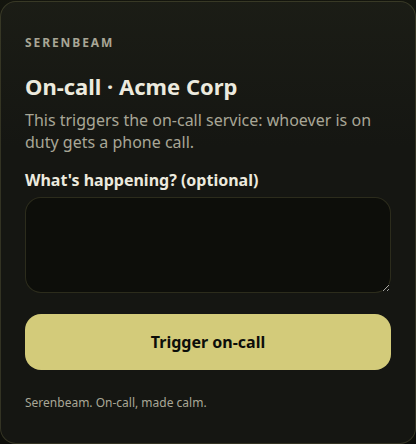
You send each client a private activation link. It opens a page with one big button and nothing else. They press it, and Serenbeam calls whoever is on duty right now. No account, no app, no dashboard to learn.
Clients with their own tooling can trigger the same thing through a webhook instead.
One incident, line by line
Every call is written down: who was reached, who took it, who closed it. This is a real transcript, not a summary you have to trust.
| Time | Event | Detail |
|---|---|---|
| 21:04:11 | opened | client pressed the link |
| 21:04:12 | call | Luca Ferretti |
| 21:09:12 | timeout | 5 min, no answer |
| 21:09:13 | escalate | calling Sofia Marino |
| 21:09:24 | ack | Sofia Marino took it |
| 21:31:20 | resolved | closed by Marta Bellini |
Get a demo call
We'll call you back within one working day. No credit card.
Simple pricing
No per-seat tax. No incident fees. Flat monthly rate, cancel anytime.
Every plan starts with 14 days free. No card required.
Frequently asked questions
Does Serenbeam really call responders by phone?
Yes. When a client opens an incident, Serenbeam places a real voice call to whoever is on call. If they don't acknowledge within the time you set (5 minutes by default), it calls the next responder in the escalation policy. Push notifications can be missed at 3am; a phone call is hard to sleep through.
How much does Serenbeam cost?
A flat €9/month (Starter: up to 5 responders, 1 rotation) or €29/month (Team: unlimited responders, multiple rotations). Phone-call escalation and unlimited incidents are included in every plan; there is no per-user pricing. Every plan starts with a 14-day free trial, no credit card required.
Is Serenbeam an alternative to Opsgenie?
Yes. Atlassian stopped selling Opsgenie in June 2025 and will delete all data in April 2027. Serenbeam is built as the low-cost successor for agencies and small teams: on-call rotations, phone-call escalation and a full incident log, set up in minutes instead of days.
How is Serenbeam different from PagerDuty?
PagerDuty is priced per user and built for internal ops teams alerted by monitoring tools. Serenbeam is flat-priced and built for agencies and MSPs whose clients report the incidents: each client gets a private activation link or webhook, and Serenbeam calls whoever is on duty. No app to install, nothing for the client to learn.
Do responders need to install an app?
No. Responders are reached by a normal phone call and acknowledge from the call itself or from a link. Clients trigger incidents from a one-button page or a webhook. Nobody needs an account except the person managing the rotation.
Can external clients trigger incidents directly?
Yes, that is the core of Serenbeam. You send each client a private activation link that opens a page with one button. Pressing it starts the escalation: Serenbeam calls the on-call responder, escalates if needed, and logs every step. Technical clients can use a webhook instead.